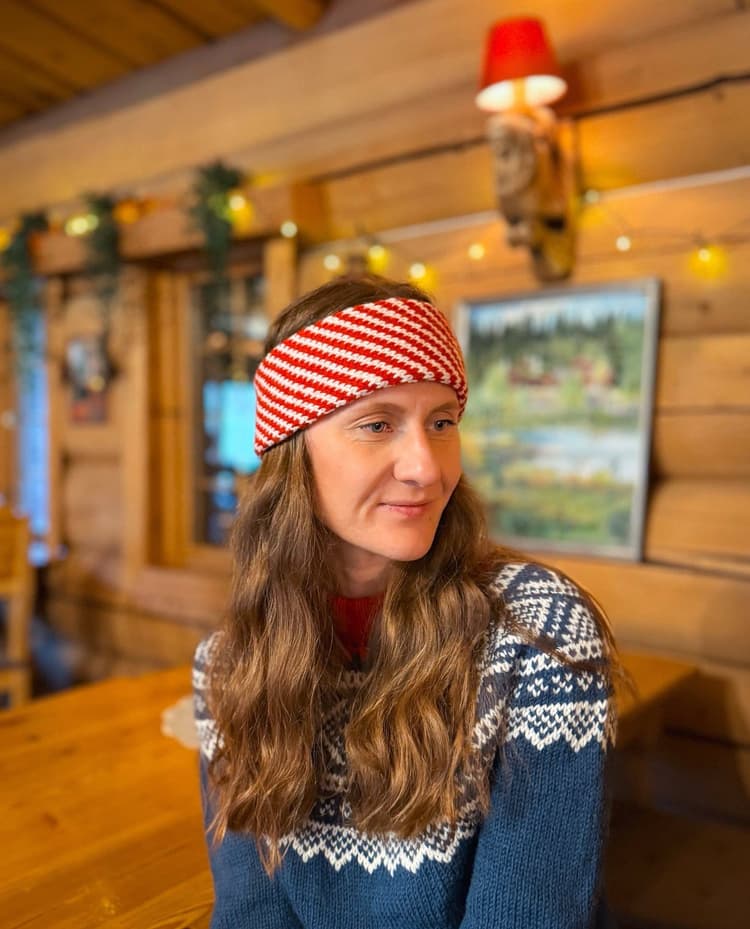
Looking for mindless knitting projects to help you relax? Maybe you need a project to work on while you watch a movie, commute, or socialise with friends? In this video, I'm sharing 12 of my favourite calming and easy knitting projects that you can work on anywhere.
If you want to support my channel, please subscribe to my channel on YouTube, leave a comment under the video, or hit the thumbs up button. Additionally, you can follow my social accounts on Instagram or TikTok ♥️
This is the right place if you are looking for a fresh knitting podcast or just want to have a knitting companion while you’re working on your project.
Here is the list of 12 mindless and free knitting projects that I shared in the video:
- Simply Stripes Baby/Lap Blanket by Elizabeth Smith - watch at 0:37
- Hudson's Bay Inspired Crib Blanket by Purl Soho - watch at 5:58
- Knitted Patchwork Recipe by Martine Ellis - watch at 7:35
- Garter Chevron Blanket by Catherine Anderson - watch at 15:27
- The Simple Thing by Melina Brell - watch at 16:17
- Stripes Please by Amy Gunderson - watch at 17:55
- Noro Striped Scarf by Jared Flood - watch at 20:26
- Favorite Socks by Kristin Lehrer - watch at 22:27
- Basic Beginner Bed Socks by Shelby Nichols - watch at 24:22
- Head Sock by Amanda Steck - watch at 28:14
- Two by Two by Anne Gagnon - watch at 29:41
- Knitting Club Sweater by Bare Knit (Etsy) - watch at 30:47
Do you ever want to knit without having to look at a chart, count rows, or think at all? Below are my notes on every pattern: the yarn weight it calls for, what makes it mindless, and a few tricks that make it even easier. All 12 patterns are free.
Blankets
A blanket is the first thing I think about when I think of mindless knits.
Simply Stripes Baby/Lap Blanket by Elizabeth Smith
This is the ultimate "one more row" project. Simply Stripes Baby/Lap Blanket is all garter stitch: you knit it flat, and it is the knit stitch all the way. Knit one side, turn your work, knit the other side. Super simple, and of course, mindless.
What makes it fun is the colour changes. It is perfect for using up scraps, or that one precious skein of variegated yarn that you didn't know where to use.
I have a very similar blanket myself. I didn't use this particular pattern, but the logic is all the same: several rows of one colour, then attach another colour, and so on. Mine is unfinished, and it is just enormous. I didn't measure, but it is definitely over 2 m wide. This is the project I pick up when I'm not sure what I want to knit, or when I want to watch my favourite TV show, be cosy, and not think about my knitting.
The main colour is a dark green Plötulopi from Ístex, an Icelandic unspun yarn. I brought about five plates of it from a trip to Iceland a couple of years ago. All the other colours are scraps from different projects. Some of them are really old, some are fresher. If you want to know more about knitting with unspun yarn, I talked about it in Episode 9.
A few things to keep in mind:
- The pattern calls for bulky yarn. Whatever you choose, it makes sense to keep more or less the same yarn weight in the whole blanket, otherwise your stripes will look a bit different from each other. You can also combine thinner yarns: in one of my pinkish stripes I held a lace weight yarn together with a fingering weight one.
- Garter stitch grows. Expect the blanket to get noticeably bigger after you wash it.
- No pressure to make it perfect. It is a scrap blanket, so I just go with the flow. If I feel like a stripe should be four rows, it will be four rows. If I'm running out of yarn, it will be two.
- Weave in the ends as you go. With stripes you will have a lot of them, and having a thousand ends to weave in at the very end can be super discouraging. (Yes, I did my homework on this one!)
- It is useful before it is finished. Mine is still on the needles, with several cords joined together, but it is already big enough to put on my lap when I need some warmth.
Hudson's Bay Inspired Crib Blanket by Purl Soho
Hudson's Bay Inspired Crib Blanket is quite similar to the previous one: also a garter stitch blanket. But here, if you follow the pattern, the main colour is very prevalent, like 90% of the blanket, and you add just a couple of stripes. It makes the blanket look very classy, and the stripes still add some playfulness. I just love how it looks with the white main colour and the bright stripes.
The pattern calls for worsted weight yarn. It is a baby blanket, so it is quite small in the instructions. But with this type of project you don't have to follow the pattern exactly. Check your gauge, cast on more stitches, and you can make it as wide and as long as you want. And the stripes are again a nice way to use your scrap yarn.
Knitted Patchwork Recipe by Martine Ellis
Knitted Patchwork Recipe is fun because you can make it in two different ways:
- Knit the squares separately and then sew them together, or join them with a crochet hook. This way you don't have to carry a huge blanket with you as it grows. You just take one or two squares, depending on how quick you knit.
- Attach the squares on the go. The pattern explains how. You pick up half of the stitches from the squares that are already made and cast on the other half, so the blanket grows diagonally, like a diamond.
I have a very similar blanket that uses the same logic, and I attach the squares as I go. Here is how my squares work:
- I use 40 stitches per square. For the very first square, cast on all 40 and knit one row.
- On the next row, knit 18 (half of the stitches minus two), then slip, slip, knit, then knit two together, and knit the remaining 18.
- Turn the work and knit all the stitches.
- Repeat: knit until half of the stitches minus two, slip, slip, knit, knit two together, knit the rest. So you decrease two stitches on every other row, and in the end you have a square.
- For the next square, cast on 20 stitches and pick up 20 from the edge of the first square (or the other way around: pick up 20, then cast on 20), and decrease in the same way.
- When a new square sits in the corner between two others, you don't cast on anything: pick up 20 stitches from one square and 20 from the other.
You can make the squares bigger or smaller. Go with 60 stitches, or with 20 or 30 if you want really tiny squares. It would look super fun as well.
My main colour is white Finull from Rauma: 100% wool, non-superwash, 350 m in 100 g, so I think technically it is a sport weight. All the other squares are leftovers from some projects, yarn that I picked up on discount, or just colours that I liked. They are not all the same thickness. The red one is Alpaca from Drops, I think it is fingering weight. I once bought a big bag of random coloured balls of it. One of the purple ones, I think, is even DK, and I can't remember what yarn it is. Whatever I have that is more or less the same weight, it goes in. It's a blanket. Nobody expects it to look perfect. It should look homey, a bit scrappy, and very handmade.
My blanket is maybe 60% done. About the ends: I did not do my homework as well as with the striped blanket! Normally I knit 10 or 20 squares, and then one evening, in front of a TV show, I decide that this is the time to sit and weave in ends.
I knit this blanket in waves. For a whole week I would only knit this and add a bunch of new squares, and then I might not pick it up for half a year. And it doesn't bother me at all.
Garter Chevron Blanket by Catherine Anderson
Garter Chevron Blanket looks super cool. I haven't made it yet, but I have a very strong feeling that it might be my next blanket, once I'm done with at least one of those two.
It looks quite complicated, but in fact it is not. It is also garter stitch: one row you just knit, and on the other row you increase and decrease.
Scarves
What is nice about scarves: they are not too big, so you can carry the project with you. That gets difficult with a blanket once it becomes a really big thing.
The Simple Thing by Melina Brell
An everyday accessory that looks super, super cute. The Simple Thing is garter stitch again, with a slipped stitch edge that looks very cute. The only tricky part is to memorise where you do the increases, and later the decreases, that give the scarf its shape. Normally you knit a couple of rows back and forth, and then increase. Once you have memorised that, you can take part in a conversation or stand in a waiting line while you knit.
The pattern calls for DK weight yarn, but I think you can swap the yarn weight here. Just make sure the scarf is as wide as you want it to be once you are done with the increases. And you can make it as long as you want, so it wraps around your neck several times.
Stripes Please by Amy Gunderson
Yet another project with stripes. You can tell that I have a very big love for stripes!
Stripes Please is fun because you don't have to turn the work. You knit it in the round, so basically you knit a really, really long tube in stockinette stitch. Several rounds with one colour, then several rounds with another. You know the drill. Just knit, knit, knit.
It calls for fingering weight yarn, so it is a great project for your fingering leftovers, if you still have any stash left after all those blankets. In the sample, the designer used black for every other stripe and different colours in between. Great for playing with colours.
A trick for almost jogless stripes. When you knit in the round, you are really knitting a spiral, so at the colour change you get a little jump. My preferred way to hide it:
- Attach the new colour and knit the whole round with it, but leave the last stitch unknit.
- Insert the left-hand needle into the stitch below that last stitch, and knit them together.
This makes the last stitch a bit shorter and evens out the height of the stripe, so the jump almost disappears. There are several other ways to do it, so of course you can use the one you prefer. It is just a nice thing to have in your toolbox.
Noro Striped Scarf by Jared Flood
A super fun and yet easy project: Noro Striped Scarf is basically a one by one rib scarf. All the magic happens when you use a long gradient yarn. The designer used Noro.
You work with two yarns in stripes. One of them can be a plain colour, and the other one is the long gradient. So every stripe comes out in a slightly different colour, but you are not juggling many similar shades to get the gradient. It is the same yarn, and it just smoothly changes colour by itself. Together with the stripes, it gives a really nice and unexpected effect.
This is my favourite of the three scarves, and I feel like it is the next project I want to cast on.
Tip: if you are not sure which yarn or colours to use, go to the pattern page on Ravelry, open the projects tab, and look through the finished projects. People add a lot of nice photos there. This is what I normally do.
Socks
Favorite Socks by Kristin Lehrer
The ultimate vanilla sock. Favorite Socks uses fingering weight yarn, it is knit cuff down, and it is stockinette stitch. The purest, most vanilla sock ever, and definitely a mindless knit.
Of course, the heel is more mindful than mindless. But if it is not your first pair, you kind of remember what to do there. And because it is fingering weight yarn, it takes more time to knit a sock, so there is a lot of mindless stockinette.
This is my top recommendation if you have never made socks before. I think it is a really nice place to start. And if you have, you can play: add stripes, or use a contrasting colour for the toes, heels and cuffs.
Basic Beginner Bed Socks by Shelby Nichols
Basic Beginner Bed Socks is a bit different from the plain vanilla sock, because it uses a rib pattern. When I make socks, I normally choose ribbing. Our feet have some shaping, and ribbing is more forgiving and sits tighter, so the fit is much better to my taste.
The pattern calls for worsted weight yarn, so these socks are quick to knit. Nice home socks, and a good idea for a gift too.
Though you need to make two! I'm usually discouraged by the second sock. I make the first one, and then I move to something else. If the pattern allows it, I knit two socks at the same time. It is a little bit slower, but when you are done, you are done. Try it if the second sock demotivates you as well.
One more reason to love socks. I love bright and variegated yarns, but I don't feel like wearing bright colours around my face every day. With socks, it's just socks, right? You can hide them in your boots. So if you have a skein that you were struck to buy and then didn't know how to use, you can always make socks with it. If the yarn is durable enough to survive as a sock, of course.
Hats
Head Sock by Amanda Steck
Head Sock is made in a very similar way to the ribbed socks. You basically knit a long tube in two by two ribbing, and you decide how long: a higher brim, a shorter one, or no brim at all. That tube is the mindless part. The crown shaping at the end requires a little bit of thinking.
It calls for fingering weight yarn. So again, if you have a skein of fingering weight that you didn't know where to use, this is a great project.
I like making hats as gifts. They are quick, and the sizing is easy to estimate. A ribbed hat is quite forgiving in width: you have a couple of centimetres of wiggle room, so you can be sure that it fits.
Two by Two by Anne Gagnon
Two by Two is super similar to the previous one: two by two ribbing again. But it calls for worsted weight yarn, so it knits up much more quickly. If the day to give the gift is approaching and you have very, very little time, this is the one to make.
And even a sweater
Knitting Club Sweater by Bare Knit
Normally sweaters are not so mindless. There is shaping, and you have to decrease the sleeves after a certain number of rounds. Something is always happening. But if it is stockinette stitch and you knit it in the round, you do the part that needs a little bit of thinking, and then you have big chunks of sweater where you can just follow the rhythm.
The Knitting Club Sweater is my own pattern. My main goal was a super easy, beginner-friendly sweater that anyone can make. If you have never made a sweater, this is the right project to start with. I also made a full video tutorial for it.
Where the mindless parts are:
- The yoke. It is a raglan sweater. The collar and the German short rows that raise the back require a little bit of thinking. After that, you have quite a lot of yoke where you just remember: one round you knit, the next round you make eight increases. The rounds get longer and longer, so it is quite time-consuming and yet mindless.
- The body. A long tube that you just knit in the round.
- The sleeves. Once you memorise where to make the decreases, you decrease, knit several rounds, and decrease again.
My tip for the sleeves: I put a stitch marker in every place where I made a decrease. Then I can easily spot where the last decrease was and I just remember how many rounds to knit until the next one. Eight or nine rounds, a decrease, a new marker, and it goes mindlessly.
New to knitting and not sure what you need to get started? Here is what you need to make your first project.
What are your mindless projects?
Have you made any of these? Which blanket and which scarf do you like the most? And what patterns do you consider mindless? Please share in the comments. I want to be inspired, because I like to have something in a drawer or on my sofa that I can just pick up and knit. My unfinished blankets have been with me for several years now, and it doesn't bother me at all. It is nice to have a project where you never have to figure out where in the pattern you left off. You know the struggle!