Hi there! Welcome to Episode 10 of my knitting podcast ❤️ Ten episodes is quite a milestone for me, so let's celebrate a little bit!
In this episode I will walk you through one finished object - the sweater I started on my trip to Iceland - and three works in progress: a dress with sequins, a tote bag and a hoodie. In the end I will show you the yarn and fiber that I brought home from Iceland.
If you want to support my channel, please subscribe, leave a comment under the video, and hit the thumbs-up button.
Chapters
- Intro (0:00)
- Never Too Late Sweater by Minimi Knit Design (0:38)
- Eve Dress by Le Pull (10:58)
- Weekend Tote by Purl Soho (24:42)
- Traveler Hoodie by Andrea Mowry (28:35)
- Acquisitions from Iceland (38:31)
Patterns and other things that I've mentioned in this video:
- Never Too Late Sweater by Minimi Knit Design, knit in an unidentified 70% cashmere and 30% cotton blend yarn and a little bit of 100% Peruvian highland wool from Lille Rille.
- Eve Dress by Le Pull, knit with 2 strands of Sequin Yarn from Wolle Halle (color - Smaragd AJ081) and 1 strand of Combine & Shine from Katia Yarn (color - 20).
- Weekend Tote by Purl Soho, knit in Drops Paris (color - 35).
- Traveler Hoodie by Andrea Mowry, knit in Dansk Pelsuld 8/2 from Hjelholts Uldspinderi (color - 31).
- Fjallalopi and Plötulopi from Ístex, and Yarnadelic fiber tops from John Arbon Textiles (color - Pink Moon).
Finished: Never Too Late Sweater
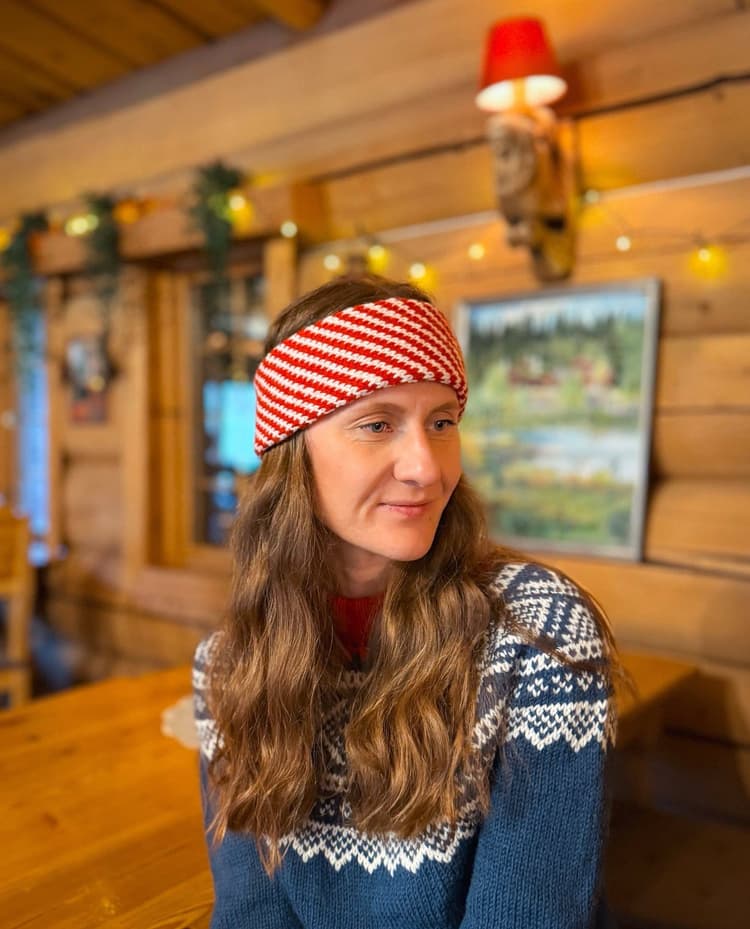
This is the one I'm wearing in the video. If you watched my Iceland episode, you know a little bit about the drama around this sweater. The plan was to cast on on the plane to Iceland, knit in between the hikes, and finish before my plane touched the ground back in Norway. It failed! Sorry for spoiling. But finally the sweater is done.
It has 3/4 sleeves and it is a little bit shorter than a normal sweater, but not too cropped.
Project details:
- Pattern: Never Too Late Sweater by Minimi Knit Design.
- Main yarn: a light blue cashmere and cotton blend, 70% cashmere and 30% cotton, 500 m in 100 g. I don't know who produces it. I bought it on Woolyknit, and as far as I understand they buy leftovers from producers and store closings and sell them on, so the yarn comes without any label - just the fiber content.
- Contrasting yarn: a hand-dyed yarn from Lille Rille, 100% Peruvian highland wool, fingering weight, 420 m in 100 g. I bought it at one of the yarn festivals here in Oslo. It looks like a unicorn, I love it so much!
- Needles: 4 mm (US 6) for the main fabric and 3 mm (US 2.5) for the ribbing.
- Size: 3, with a few stitches less on the body.
How I played yarn chicken and (kind of) won
I had 350 g of the blue yarn. When I bought it, I planned to knit it with a single strand, and for my size that is usually enough for a light fingering weight yarn. But this pattern is knit with the yarn held double, and that changed the math. I couldn't buy more: whatever you buy from a shop like that is a one-time chance.
So for the main fabric I held two strands of the blue yarn together. For the ribbing on the sleeves, the body and the collar I held one strand of blue together with one strand of the colorful hand-dyed yarn. This way the main color lasted longer. The colorful yarn also went into the ties on both sides.
The effect is so subtle, but it gives a lot of freshness and life to the sweater. I really like how it turned out!
I also made some safety modifications while I was still knitting the yoke. I had exactly the yardage the pattern asks for, and I wanted longer sleeves and a longer body than the pattern has. Designers usually add 10-15% to the yardage just in case, and I reused the yarn from my swatch, so I was hoping to stay on the optimistic side. But to be safe I didn't increase to the full stitch count for size 3. Maybe 8 stitches less on the body. So it is somewhere in between size 2 and 3, a little bit narrower but longer. What was left in the end: not much, but enough!
About hand-dyed yarn
Every time I see yarn in hanks, I can't be sure how it will look once you cake it and start knitting. The color changes can be long or short, or speckled. It is a surprise every time. What usually stops me from buying hand-dyed yarn is very long color changes: they give you a weird pooling effect on a garment. There are ways to minimize it, like alternating skeins, but sometimes you just can't. This one has short changes and subtle colors, and it looks amazing.
It is a lightweight sweater that I can pair with a dress or throw on in the chillier summer evenings. For Norwegian winters it is not warm enough, but for the in-between seasons and colder summer days - and let's be fair, they happen often in Oslo - it is really nice to have.
WIP 1: Eve Dress with sequins
This is the most exciting one. Look how gorgeous the color is! This is the most perfect green for me. It is my first time knitting with sequins and my first time knitting a dress. The plan is to have it ready for the December festivities.
For once I'm using the yarn suggested by the pattern - one of the very few times that happened to me!
Project details:
- Pattern: Eve Dress by Le Pull.
- Yarn: 2 strands of Sequin Yarn from Wolle Halle (100% cotton, color Smaragd AJ081) held together with 1 strand of Combine & Shine from Concept by Katia (80% viscose, 20% polyester, color 20, black).
- Needles: 3.75 mm (US 5).
- Size: 3, with 4 stitches less. I'm on the edge of size 3, and the dress has a lot of ease.
Why green and black? Combine & Shine doesn't come in many colors, and their green was quite light. I wanted a deep green, so I took the black strand to make the green of the sequin yarn a bit darker.
The struggles
Everything comes on cones, and the sequins grab the yarn. When you pull, a sequin holds the strand somewhere, and you have to stop, take the cone and free it. It takes time. The sequins also try to stay on the wrong side of the fabric, and I'm doing my best to keep them on the right side, so it is shinier and less scratchy on the inside. There are still plenty on the inside, but there are plenty on the outside too.
But honestly, I have never tried on a project as often as this one. It is shiny and lovely, and I can't wait to be done with it.
My modifications
- Knitting instead of purling. The right side of the dress is the purl side. If you follow the pattern, you purl a lot. Once I had joined the front and the back to work in the round, I purled two or three rounds, then used the German short row trick to turn my knitting and continued knitting on the other side. Now there is no purling at all, and it is much more pleasant.
- More stitches at the cast on. I cast on the number of stitches for size 4, even though I'm knitting size 3, because I wanted the yoke a little bit wider than in the designer's sample. I just like that look better.
- Slower increases. I'm much taller than the designer, and her sample is quite short. I will add fabric to the bottom of the dress, so I don't want it to grow too wide. I increase less often than the pattern says, so the gap between the increases is larger.
- Earlier increases. I started the shaping for the front and the back a bit earlier, maybe 1-1.5 cm. The armhole in the sample is quite wide, and three strands of yarn will make the dress heavy and pull it down even more. I wanted to avoid that.
- Pockets (planned). I have a sewn dress in the store with a very similar shape, and it has pockets, so I'm going to steal that idea. The plan: knit until I reach the pocket height, separate the front and the back, knit each back and forth to the depth of the pocket, then join again. Later I will sew the pocket bags in. I have never made pockets before, so a lot of new things in one project!
One warning from Ravelry: people who knit with this sequin yarn say don't even try to unravel, just cut and start from scratch. I had to unravel at the very beginning, and it was painful. So now I'm paying extra attention, and my row counter is there to make sure I don't miss an increase.
WIP 2: Weekend Tote
Yet another kind of project I have never made before: a bag. It is the Weekend Tote by Purl Soho, a free pattern on their website, and I'm making the small size.
Project details:
- Yarn: Drops Paris, 100% cotton, 150 m in 100 g, color 35. It looks bright on the video, but in real life it is a pastel yellow.
- Plan: once the knitting is done, embroider a few flowers on it to make it even more colorful and happy.
The construction is simple. You cast on the bottom of the bag and knit it back and forth into a rectangle. Then you pick up stitches all around the rectangle and knit in the round. That's where I am now. The yarn is quite thick, so it goes fast, and it is a very mindless project. A colleague warned me that the instructions get messier once you split for the straps, but I'm not there yet. Stay tuned!
WIP 3: Traveler Hoodie, version 2
This one is a long-lasting WIP. I started it in July last year, finished the yoke, and abandoned it right when I had to pick up stitches for the sleeves. Dividing the area for the pick-up and counting the stitches takes a lot of brain power, so I kept postponing it. But I love the yarn so much that I finally returned to it.
This is my second Traveler Hoodie. The first one is one of my most worn garments: a lot of positive ease, a hood, and it goes with anything. I talked about it in Episode 6.
Project details:
- Yarn: Dansk Pelsuld 8/2 from Hjelholts Uldspinderi, 100% wool, 400 m in 100 g, color 31. A deep red with a lot of depth. I bought it a year ago on a trip to Copenhagen.
- Needles: 3 mm (US 2.5).
- Size: 3.
- Gauge: the pattern calls for sport weight and my yarn is fingering weight, but my swatch matched the gauge in the pattern. And with this much positive ease a little difference wouldn't bother me anyway.
The provisional cast on trick
The pattern is knit from the bottom up. I did the same trick as with my first Traveler: I cast on in the underarm area with a provisional cast on and knit the yoke up to the top. Once the sleeves and the hood are done, I will pick up those stitches and knit the body down, and bind off when the length satisfies me.
Why? I'm tall and I always add length to the body and the sleeves. The stitch pattern here is 3 knit rounds and 2 purl rounds, and it grows a lot after blocking. If I add too much, I can just unravel a couple of rounds and bind off again. Knit bottom up, you would have to cut, which is much more complex.
The drama: I told this story in the Lofoten episode. I cast on, knit around 10 rounds, split for the front and the back, finished the front, and when I picked up stitches for the back, I found out that my knitting was twisted. Luckily I hadn't knit much in the round, so I cut the yarn, unraveled the rounds, kept the front, cast on again for the back, and joined them afterwards. So please, once you join in the round, make 100% sure your cast on is not twisted!
By the way, the stitch marker you can see on the sweater in the video is from the Iceland episode: I put it there to show how far I got with two balls of yarn. It can go now.
Acquisitions from Iceland
Of course I had to bring some Icelandic wool home.
- Fjallalopi from Ístex. I think it is a new yarn, because I hadn't heard about it before. 100% wool, a sport weight, 300 m in 100 g, rustic and a bit scratchy. I bought a sweater quantity: 6 balls of light blue (color 324) as the main color, 2 balls of white as the main contrasting color, and one ball each of a few other colors (green, yellow, and pink). All the colors except the white have a black undertone, so I guess it is undyed black sheep wool underneath. It looks amazing. No pattern yet - maybe I will come up with something myself.
- Two plates of Plötulopi in deep forest green. I'm knitting a garter stitch scrap blanket: 4 rows of this green, then 2 rows of colorful leftovers from other projects. It is already 2 meters wide or more, and I was afraid I would run out of the green, so I bought two more plates.
- Yarnadelic fiber tops from John Arbon Textiles, color Pink Moon. 100 g of 100% Falkland Corriedale, for spinning. Not Icelandic, but they had it and I don't see it here. I'm quite new to spinning, and people in the podcasts I watch say Corriedale is nice to spin and nice to wear. What it becomes will depend on how I spin it, but my spinning is improving gradually!
Have you ever knit with sequins? Did you have the same struggles, or is it just me? Let me know in the comments!